
Blog

Blog
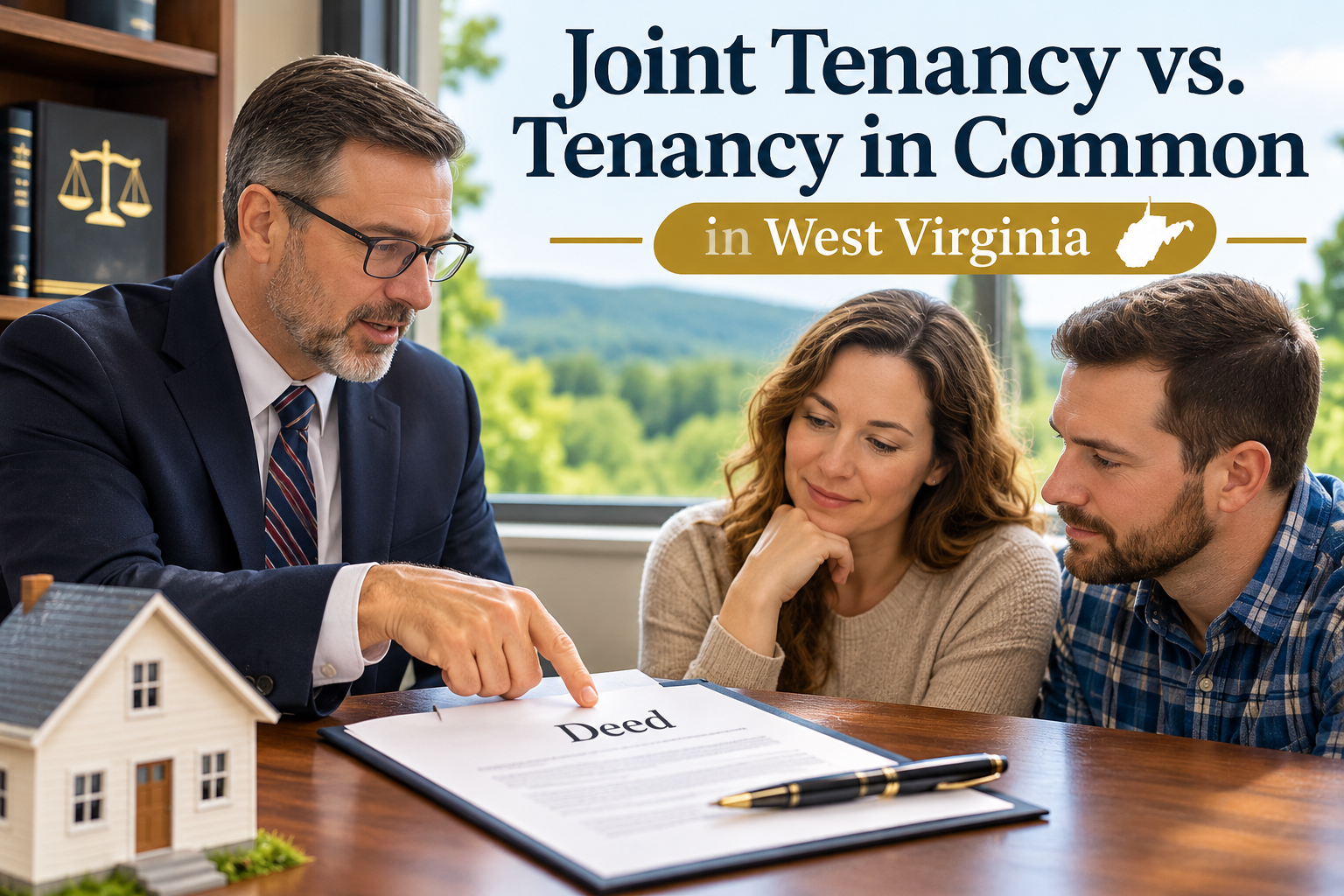
Joint Tenancy vs. Tenancy in Common in West Virginia
Joint Tenancy vs. Tenancy in Common in West Virginia
When two or more people buy property together, most of their attention goes to the price, the loan and the closing date. One line in the deed often gets far less thought: the line that says how the buyers will own the property together. That choice decides what happens to each owner's share of the property if one of them dies, whether an owner can sell or leave their share to someone else, and whether the property goes through probate.
At Moye Law Firm, we prepare deeds and handle closings as part of our real estate law services in Winfield and Cross Lanes. This guide explains the two main forms of shared property ownership in West Virginia in plain English so you can choose an ownership structure before you sign.
Why the Form of Property Ownership Matters

How co-owners hold title is often called "vesting." It is written into the deed and controls three big questions:
What happens to the property when one owner dies? Does their share go automatically to the other owner, or does it pass under their will or to their heirs?
Can one owner sell or convey property interests without the others?
How is ownership divided? In equal shares, or by ownership percentage?
Two deeds for the same house, with the same buyers, can lead to very different results depending on a few words.
What Is Tenancy in Common?
A tenancy in common is a form of property ownership in which each owner holds a separate ownership interest in the whole property. Key features:
Unequal shares are allowed. One owner can hold 60% and another 40% if the deed says so, which lets the ownership percentage reflect each person's financial contributions.
No automatic survivorship. When a tenant in common dies, their interest in the property does not go to the other owners automatically. It passes under their will or to their heirs.
Shares can be transferred. An owner can generally sell, give away or leave their share without the other owners' permission.
Every owner can use the whole property. Each co-owner may possess and use the entire property, not just "their" portion.
Tenancy in common offers flexibility, so it is common among business partners, investors, friends buying together, and blended families where each owner wants their share to go to their own children.
In West Virginia, when a deed names two or more owners and does not clearly say otherwise, the owners are generally treated as tenants in common.
What Is Joint Tenancy With Right of Survivorship?
Joint tenancy with right of survivorship is a form of ownership in which, when one owner dies, their interest passes automatically to the surviving joint tenant or tenants. Key features:
Survivorship. The surviving joint tenant takes the deceased owner's interest without that share passing through the will.
Equal ownership. Joint tenants generally share equal interests in the property.
Wills don't control. Unlike tenancy in common, a joint tenant generally cannot leave their share to someone else in a will while the survivorship arrangement is in place.
Many married couples, and some parents and adult children, choose survivorship because it can make the transition simpler when one owner passes away.
The West Virginia Detail: Say It in the Deed
In West Virginia, survivorship generally does not happen just because two people are listed as "joint tenants." To create a joint tenancy with survivorship, the deed must clearly state that the owners hold title with a right of survivorship. If that language is missing, the deceased owner's share may go to their heirs instead of the surviving co-owner, which is exactly what many couples were trying to avoid. Our post on heir property in West Virginia explains how ownership can split among family members when that happens.
What About Tenancy by the Entirety?
You may see "tenants by the entirety" online. In states that recognize it, it is a special form of ownership for married couples that includes survivorship and certain protections from one spouse's individual creditors. Whether that form is available for property in West Virginia, and what it does or does not offer here, should be confirmed with an attorney before you rely on it.
Key Differences Between Joint Tenancy and Tenancy in Common

Tenancy in Common | Joint Tenancy With Survivorship | |
|---|---|---|
Ownership interest | Equal or unequal shares | Generally equal shares |
When an owner dies | Share passes by will or to heirs | The surviving joint tenant generally takes the share |
Transferring a share | Generally allowed | A transfer may sever the joint tenancy for that share |
Common uses | Investors, friends, blended families | Spouses, some parent/child owners |
Deed wording | The default when survivorship isn't stated | Survivorship must be expressly stated |
Joint Tenants vs. Tenants in Common: Advantages and Disadvantages
Tenancy in common: advantages
Ownership can match each person's financial contributions.
Each owner decides who inherits their share.
Tenancy in common: disadvantages
A deceased owner's share usually goes through probate.
You may end up co-owning with a stranger or with heirs you didn't choose.
Joint tenancy: advantages
The surviving joint tenant generally takes the property without probate for that asset.
Simple and familiar for married couples.
Joint tenancy: disadvantages
You can't leave your share to someone else by will.
Shares are generally equal even if contributions weren't.
It can end unexpectedly if one owner transfers their share.
How Each Option Affects Probate and Estate Planning
Your deed and your estate plan need to work together. Because survivorship on the deed generally controls over a will, a joint tenancy can override what your will says about that property. A tenancy in common leaves your share to your estate plan, which gives you control but usually means probate for that share. Some families use a trust or a transfer-on-death deed instead. Our estate planning services can help line up the deed with your will or trust.
The form of ownership can also matter for taxes, such as capital gains when the property is sold after an owner's death, and for property taxes. Ask a tax professional about your situation.
Can a Joint Tenancy Be Severed or Changed?
Yes. Owners can generally change the form of ownership by recording a new deed, for example, converting tenants in common to joint tenants with survivorship, or the reverse. A joint tenancy may also be severed if one owner conveys their share to someone else. If you are adding someone to an existing deed, see our guide to Adding or Removing someone from a Deed in West Virginia
What If Co-Owners Disagree?
Shared ownership works well when everyone agrees. When co-owners can no longer agree on whether to keep, sell, or divide property, West Virginia law provides a court process called partition, which can end with the property being divided or sold. A written co-ownership agreement made at the start, covering expenses, use, and buyouts, can help avoid that. Divorce raises its own ownership questions, covered in our post on how title and ownership are handled in a West Virginia divorce.
Frequently Asked Questions
What's better, joint tenancy or tenancy in common?
Neither is better for everyone. Joint tenancy often suits spouses who want the survivor to keep the home. Tenancy in common often suits co-owners who contributed different amounts or want their share to go to their own heirs.
How do I know if I own property as joint tenants or tenants in common?
Read your recorded deed. Look for language about survivorship. If it isn't there, West Virginia generally treats co-owners as tenants in common. A real estate attorney can review the deed if the wording is unclear.
Can tenants in common own unequal shares?
Generally yes, if the deed states each owner's share.
Can joint tenancy be changed to tenancy in common?
Generally yes, usually by a new deed. See the severance section above.
Talk With Moye Law Firm About Your Deed
How you hold title is a decision to make deliberately, ideally before the deed is drafted. Our real estate practice includes deed preparation and closing representation, and Attorney Lisa M. Moye focuses on Real Estate Law and Wills and Estates, so we can look at both how you hold title and how it fits your estate plan.
Call our Winfield office at (304) 586-1251 or our Cross Lanes office at (304) 693-2331. Our offices are open Monday through Friday from 8:30 a.m. to 4:30 p.m., with Saturday appointments available.
This article provides general information about West Virginia real estate and is not legal advice. Reading it does not create an attorney-client relationship.

Moye Law Offices
We have two offices in West Virginia: Winfield and Cross Lanes.
CROSS LANES
Joint Tenancy vs. Tenancy in Common in West Virginia
Joint Tenancy vs. Tenancy in Common in West Virginia
When two or more people buy property together, most of their attention goes to the price, the loan and the closing date. One line in the deed often gets far less thought: the line that says how the buyers will own the property together. That choice decides what happens to each owner's share of the property if one of them dies, whether an owner can sell or leave their share to someone else, and whether the property goes through probate.
At Moye Law Firm, we prepare deeds and handle closings as part of our real estate law services in Winfield and Cross Lanes. This guide explains the two main forms of shared property ownership in West Virginia in plain English so you can choose an ownership structure before you sign.
Why the Form of Property Ownership Matters
How co-owners hold title is often called "vesting." It is written into the deed and controls three big questions:
What happens to the property when one owner dies? Does their share go automatically to the other owner, or does it pass under their will or to their heirs?
Can one owner sell or convey property interests without the others?
How is ownership divided? In equal shares, or by ownership percentage?
Two deeds for the same house, with the same buyers, can lead to very different results depending on a few words.
What Is Tenancy in Common?
A tenancy in common is a form of property ownership in which each owner holds a separate ownership interest in the whole property. Key features:
Unequal shares are allowed. One owner can hold 60% and another 40% if the deed says so, which lets the ownership percentage reflect each person's financial contributions.
No automatic survivorship. When a tenant in common dies, their interest in the property does not go to the other owners automatically. It passes under their will or to their heirs.
Shares can be transferred. An owner can generally sell, give away or leave their share without the other owners' permission.
Every owner can use the whole property. Each co-owner may possess and use the entire property, not just "their" portion.
Tenancy in common offers flexibility, so it is common among business partners, investors, friends buying together, and blended families where each owner wants their share to go to their own children.
In West Virginia, when a deed names two or more owners and does not clearly say otherwise, the owners are generally treated as tenants in common.
What Is Joint Tenancy With Right of Survivorship?
Joint tenancy with right of survivorship is a form of ownership in which, when one owner dies, their interest passes automatically to the surviving joint tenant or tenants. Key features:
Survivorship. The surviving joint tenant takes the deceased owner's interest without that share passing through the will.
Equal ownership. Joint tenants generally share equal interests in the property.
Wills don't control. Unlike tenancy in common, a joint tenant generally cannot leave their share to someone else in a will while the survivorship arrangement is in place.
Many married couples, and some parents and adult children, choose survivorship because it can make the transition simpler when one owner passes away.
The West Virginia Detail: Say It in the Deed
In West Virginia, survivorship generally does not happen just because two people are listed as "joint tenants." To create a joint tenancy with survivorship, the deed must clearly state that the owners hold title with a right of survivorship. If that language is missing, the deceased owner's share may go to their heirs instead of the surviving co-owner, which is exactly what many couples were trying to avoid. Our post on heir property in West Virginia explains how ownership can split among family members when that happens.
What About Tenancy by the Entirety?
You may see "tenants by the entirety" online. In states that recognize it, it is a special form of ownership for married couples that includes survivorship and certain protections from one spouse's individual creditors. Whether that form is available for property in West Virginia, and what it does or does not offer here, should be confirmed with an attorney before you rely on it.
Key Differences Between Joint Tenancy and Tenancy in Common
Tenancy in Common | Joint Tenancy With Survivorship | |
|---|---|---|
Ownership interest | Equal or unequal shares | Generally equal shares |
When an owner dies | Share passes by will or to heirs | The surviving joint tenant generally takes the share |
Transferring a share | Generally allowed | A transfer may sever the joint tenancy for that share |
Common uses | Investors, friends, blended families | Spouses, some parent/child owners |
Deed wording | The default when survivorship isn't stated | Survivorship must be expressly stated |
Joint Tenants vs. Tenants in Common: Advantages and Disadvantages
Tenancy in common: advantages
Ownership can match each person's financial contributions.
Each owner decides who inherits their share.
Tenancy in common: disadvantages
A deceased owner's share usually goes through probate.
You may end up co-owning with a stranger or with heirs you didn't choose.
Joint tenancy: advantages
The surviving joint tenant generally takes the property without probate for that asset.
Simple and familiar for married couples.
Joint tenancy: disadvantages
You can't leave your share to someone else by will.
Shares are generally equal even if contributions weren't.
It can end unexpectedly if one owner transfers their share.
How Each Option Affects Probate and Estate Planning
Your deed and your estate plan need to work together. Because survivorship on the deed generally controls over a will, a joint tenancy can override what your will says about that property. A tenancy in common leaves your share to your estate plan, which gives you control but usually means probate for that share. Some families use a trust or a transfer-on-death deed instead. Our estate planning services can help line up the deed with your will or trust.
The form of ownership can also matter for taxes, such as capital gains when the property is sold after an owner's death, and for property taxes. Ask a tax professional about your situation.
Can a Joint Tenancy Be Severed or Changed?
Yes. Owners can generally change the form of ownership by recording a new deed, for example, converting tenants in common to joint tenants with survivorship, or the reverse. A joint tenancy may also be severed if one owner conveys their share to someone else. If you are adding someone to an existing deed, see our guide to Adding or Removing someone from a Deed in West Virginia
What If Co-Owners Disagree?
Shared ownership works well when everyone agrees. When co-owners can no longer agree on whether to keep, sell, or divide property, West Virginia law provides a court process called partition, which can end with the property being divided or sold. A written co-ownership agreement made at the start, covering expenses, use, and buyouts, can help avoid that. Divorce raises its own ownership questions, covered in our post on how title and ownership are handled in a West Virginia divorce.
Frequently Asked Questions
What's better, joint tenancy or tenancy in common?
Neither is better for everyone. Joint tenancy often suits spouses who want the survivor to keep the home. Tenancy in common often suits co-owners who contributed different amounts or want their share to go to their own heirs.
How do I know if I own property as joint tenants or tenants in common?
Read your recorded deed. Look for language about survivorship. If it isn't there, West Virginia generally treats co-owners as tenants in common. A real estate attorney can review the deed if the wording is unclear.
Can tenants in common own unequal shares?
Generally yes, if the deed states each owner's share.
Can joint tenancy be changed to tenancy in common?
Generally yes, usually by a new deed. See the severance section above.
Talk With Moye Law Firm About Your Deed
How you hold title is a decision to make deliberately, ideally before the deed is drafted. Our real estate practice includes deed preparation and closing representation, and Attorney Lisa M. Moye focuses on Real Estate Law and Wills and Estates, so we can look at both how you hold title and how it fits your estate plan.
Call our Winfield office at (304) 586-1251 or our Cross Lanes office at (304) 693-2331. Our offices are open Monday through Friday from 8:30 a.m. to 4:30 p.m., with Saturday appointments available.
This article provides general information about West Virginia real estate and is not legal advice. Reading it does not create an attorney-client relationship.
Moye Law Offices
We have two offices in West Virginia:
Winfield and Cross Lanes.
CROSS LANES
We Are Here To Help
Do you have a query or problem that you would like to talk about, or are you curious to hear more about how we can help you?
Get in touch today! We look forward to hearing from you.
Assistance Hours
Monday – Friday: 8:30am – 4:30pm
Saturday: By appointment only
Sunday: CLOSED
Subscribe to our Newsletter
We Are Here To Help
Do you have a query or problem that you would like to talk about, or are you curious to hear more about how we can help you?
Get in touch today! We look forward to hearing from you.
Assistance Hours
Monday – Friday 8:30am – 4:30pm
Saturday: By appointment only
Sunday CLOSED